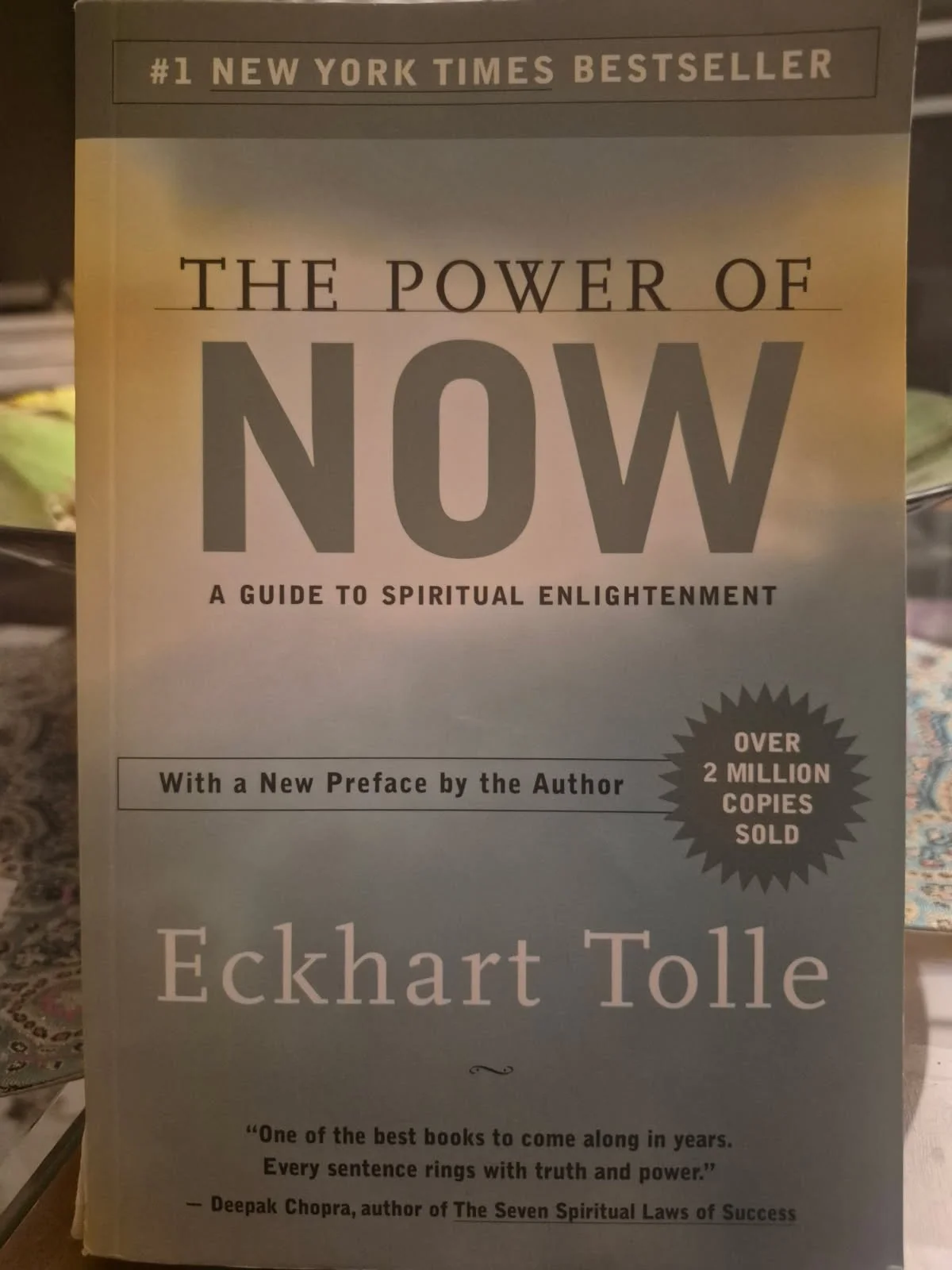
Most aspiring authors believe their biggest challenge is lack of time, lack of clarity, or lack of confidence, but Eckhart Tolle’s The Power of Now reveals a deeper truth. The real obstacle is the mind’s constant pull away from the present moment.
Tolle’s work teaches that suffering comes from living in the past or future instead of the now. The only place a book can be written is here, in this moment, with the sentence in front of you.
Let’s explore how The Power of Now becomes a practical, powerful framework for helping you write your book.
Presence: The Core Teaching
Tolle’s central message is simple: Become aware of the mind instead of being controlled by it.
You need to come out of the constant identification with the thinking mind and become present to what is happening now.
For authors, this means stepping out of:
the past (“I should have written this years ago”)
the future (“What if nobody likes my book?”)
imagined judgments
comparison
perfectionism
fear of visibility
And returning to the only moment where writing is possible, which is NOW.
How Authors Lose the Present Moment
When a writer sits down to write, the mind starts narrating:
“This isn’t good.”
“I don’t know where this chapter is going.”
“Other writers are so much farther ahead.”
“I need to do more research first.”
You may be physically sitting in the present, but mentally or psychologically, somewhere else.
This mental scattering, and not the writing itself, is what makes writing feel hard. Presence quiets that noise.
The Past and Future Create Suffering
The book also explores how our relationship with the past and future can create suffering. Tolle’s teaching invites authors to release the past and return to what is actually happening now. You can’t rewrite last year. If you wish you would’ve started earlier, that’s another method of procrastination. The past can become a source of regret and presence turns that regret into action. You can’t go back in time but you can write today.
Future‑based fear is just as paralyzing and can be a source of anxiety:
“What if nobody buys it?”
“What if I get a bad review?”
“What if I publish it and nothing happens?”
There’s a difference between planning for the future and mentally living inside an imagined future. The author writing the first chapter does not need to solve the hypothetical problem of a negative review two years from now.
Presence brings the focus back to the page. The finished book is simply the accumulation of thousands of present moments in which you chose to participate in the creation of it. You don’t write a book by thinking about the whole book. You write it by writing today’s portion.
Presence shrinks the task from writing the whole book to writing one sentence and then you keep moving once you have momentum.
Presence Creates Space for Creativity
When the mind is busy judging, comparing, and predicting, creativity suffocates. The creative mind needs room. You can have the thought that this book isn’t good without it being a fact. Presence allows authors to observe thoughts instead of obeying them. This creates space, and inside that space, writing becomes possible again.
Writing requires imagining, listening, noticing, exploring and observing. Presence opens the door to all of these.
Technique matters, and includes structure, character, and plot, voice, but you don’t necessarily have a writing problem. You may have a problem with the relationship with your own mind. Stop waiting to feel ready. If your creative life depends on the perfect circumstances arriving first, you may spend a very long time waiting.
What can you write now, with the state you’re actually in?
A Simple Practice for Writers
Stop.
Return to the body.
Notice your breathing.
Now, go write what can be done today.
The perfect future never arrives. The past cannot be changed. Your book can only be written one present moment at a time. Presence is not just a spiritual concept. It’s a writing strategy.
Many writers treat every writing session as an evaluation of their worth. Let writing be an experience of exploration, discovery, play and, joy. This is where creative flow lives.
Final Thoughts
What could you create if you stopped living in the past or future, and simply wrote the next page?
Your next chapter doesn’t require more time. It requires more presence. You don't become an author in some magical future moment when the book is finally finished. You become an author every time you choose to write.
