
storytelling

Self-Care Isn’t Just Rest: It’s Writing the Book and Creating the Life You Really Want

When you think about self-care, you probably conjure up images of baths, candles, soft pajamas, warm drinks, and taking the weekend off. Sure, these things do matter. They can soothe the nervous system and restore the body. I enjoy these refreshing experiences as much as anyone.

But lately, I’ve been thinking about another form of self-care that doesn’t always feel relaxing and comforting in the moment. Sometimes self-care looks like doing the thing your heart has been asking you to do, and that thing may be hard. It could be writing the book, changing your career, learning something new, or going back to school.

It could mean stepping into the life you keep imagining but haven’t yet allowed yourself to live.

What If Your Heart Wants More Than Rest?  

There is nothing wrong with rest. It’s necessary since we are not machines, and we don't need to turn every moment of our lives into an opportunity for productivity. However, I think we've sometimes reduced self-care to the idea of feeling good right now.

That’s where I think we can miss something, because there are things that may not feel easy in the moment but leave you feeling alive and renewed. There are experiences that challenge you, stretch you, frustrate you, and require you to learn something new, and make you feel more like yourself.

Writing can be like that. You may sit down to write and discover that you don't know what you're doing. You may stare at a blank page or question your idea or change the plot midway, but this discomfort isn’t a sign that writing is wrong for you. It’s a sign that what your heart wants you to do will require growth. Taking the action will help you with that growth.

There’s a big difference between doing something that drains you because you feel obligated to do it and doing something difficult because your heart keeps calling you to do it.

Presence: The Self‑Care That Moves You Forward

In the “Power of Now,” Eckhart Tolle teaches that the mind pulls us into the past and future, away from the only place life actually happens, which is in the present moment.

Most aspiring authors don’t struggle because they lack ideas; they struggle because they aren’t present enough to write them. You may be thinking about how you’ll never finish the book or how no one will read it. These thoughts pull you out of the present moment and cause you to keep delaying action. By returning to the moment and writing the first sentence and then the first chapter, you’re giving yourself evidence that you can do it.

You can have the most lovely self‑care routine in the world and still feel like something is missing if there is a part of your life you continually refuse to live. Your future self is shaped by the choices you make now. Self‑care does not mean only tending to your present self. It should also be tending to your future self’s destiny.

Redefining Self-Care

I’ve realized the things that make you feel most alive may also be hard to do.

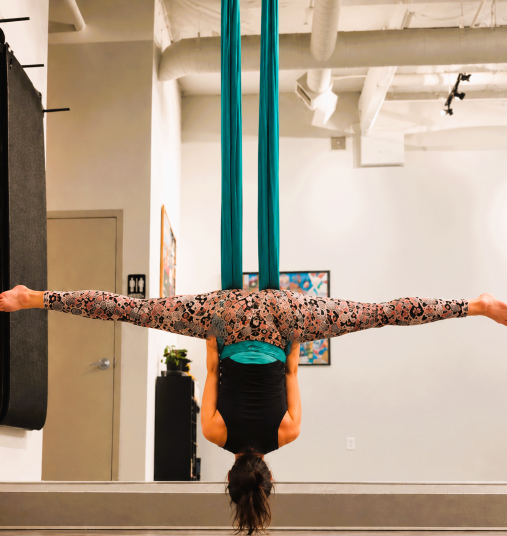
This idea has become particularly clear to me because I recently started taking aerial fitness classes. It’s hard. Although I was a gymnast throughout high school, it has been a long time. Starting aerial fitness as an adult is different from simply relaxing into a massage or taking a hot bath.

There are movements my body doesn't know how to do yet. There are things I have to practice repeatedly. There are moments when I'm wondering how I can get my body to bend like that. It takes effort and can be uncomfortable and frustrating, but I’ve wanted to try it for a long time, and I finally decided to do it.

Once I started doing it, I didn’t just experience the class as exercise. I experienced it as self-care because I was giving myself something I had wanted.

I was saying yes to a part of myself that wanted adventure, movement, challenge, play, and something outside of my normal routine. Now, I've already moved up to the next level. This makes me happy because it’s a reminder that I listened to myself and acted on my decision instead of waiting until I had more time or letting my fear of getting hurt stop me.

I wouldn’t have gotten to this place if I had kept putting it off until someday. The same goes for writing. I wouldn’t have a published book if I’d kept delaying the work. These kinds of choices don’t look like the gentle, aesthetic version of self-care we’re used to. That doesn’t mean that self-care can never be restful. It means it can also include commitment to what your heart is calling you to do.

What if writing for thirty minutes is also self-care?

What if protecting your creative time is self-care?

What if saying no to something that consumes your time so you can say yes to your book is self-care?

Different Chapters

Your life unfolds in chapters. This could be the chapter where you write the book, the chapter where you stop waiting for permission, or the chapter where you stop postponing what your heart wants you to do. Self‑care isn’t only escaping your life for an hour. It’s also creating a life you don’t need to escape from.

Your heart needs to express itself. And sometimes the most loving thing you can do for yourself is to write the first chapter, step into the studio, walk into the class, or begin the project, and give yourself permission to become the person you’ve been wanting to become.

Self‑care isn’t just tending to the life you already have. It’s creating the life your heart keeps asking you to live.


 Subscribe for your free “Decide to Write” Workbook and Author Contract to make writing more fun and easy!

Storytelling - overrated or overlooked teaching tool?

Storytelling around campfire

Image by David Mark from Pixabay

Storytelling has played a key role for humans for thousands of years. It doesn’t take money or resources to tell stories, yet it has helped build connections and relationships throughout history. Storytelling isn’t only a form of timeless entertainment but also an important and effective teaching tool that is often overlooked.

Many textbooks and lessons for children are written in a dry, formulaic manner. Children are curious and eager to learn. Although they are not born to think that school will be boring, the way that concepts and information are presented to them can cause them to lose interest and believe that the entire topic is boring.

Why is storytelling effective?

Stories don’t just engage the mind, but also aim to elicit emotions, and are helpful in teaching lessons.

In the book, How to Tell Stories to Children, authors Joseph Sarosy and Silke Rose West, illustrate why stories should be used as a vital part of teaching.

According to Rose West and Sarosy, one reason is that people are more likely to remember material from a story (2021). “Memory has as much to do with how information is taken in as how it is recalled. Attention plays a key role, telling the brain where and when to lay down tracks for the incoming information. As we all know, however, attention is a limited resource. Storytelling, along with its central characters, emotional gravity, unusual plot developments, and descriptive language, is one of the most powerful tools we have for gaining and retaining attention” (Rose West & Sarosy, 2021, p. 108).

Have you ever read the same line over and over again without paying attention and then not been able to recall what you just read a few minutes later?

We’ll remember information differently based on how we gain that information. The package that is used to deliver that information plays a key part in how much of it the learner engages with and retains.

Information presented in a dull way doesn’t have the same effect as information presented in an interesting way even though it’s the same information. Start with the end result or goal in mind – the student learns the information. Now, work backwards from there. How do I present this topic in a way that causes the audience to listen? Who is my audience? What is their knowledge level? What do they find interesting?

This method may seem time-consuming and it certainly takes more time than just regurgitating facts and statistics from a text book, but put it into the context of your goal. Your goal shouldn’t be to present the information. If that was your only goal, then obviously, reading the facts would be the fastest way to reach the goal.

Keep in mind that the goal is that the child learns the information. In that case, it is more efficient to use a story or an anecdote to present the information in an interesting way, because the extra time it takes upfront to come up with a creative package for the information will help shorten the time it takes for the learning to occur.

Fiction vs. Nonfiction  

“We did not choose books solely for their instructional value. I would even say we chose them mainly on the basis of the enthusiasm they were likely to arouse in the children – as opposed to in us, or in the school-district officials,” wrote Céline Alvarez, a bestselling researching and educator, in her book The Natural Laws of Children: Why Children Thrive When We Understand How Their Brains Are Wired (Alvarez, 2019, p. 186). She observed that the children were much more engaged when they were interested in the story.

Common Core standards required students to have nonfiction be a certain percentage of their reading instead of primarily reading fiction. Natalie Wexler, education journalist, points out in The Knowledge Gap that the argument in favor of this change toward nonfiction was that students would gain useful knowledge versus reading fiction, which didn’t teach anything. However, a challenge they ran into was that. without having relevant knowledge, the students struggled to examine or even understand the nonfiction texts. They were better able to understand fiction since it was based on familiar human behavior (Wexler, 2019).

Certainly, there are merits to reading fiction and nonfiction. Why not have both in the same text? An entertaining story that elicits enthusiasm and has educational value.

Using storytelling to teach public-speaking

I wrote Super Speaker because I wished that I had been exposed to public-speaking at a younger age, because developing my presentation skills helped me gain confidence and become a better communicator in many different arenas of life.

Sure, I could’ve just written my framework for effective public speaking – the  5 P’s of Presentations and the descriptions - and have been done with it. It would’ve taken me much less time and effort and it would take the reader much less time and effort as well. But there wouldn’t be any emotions involved. That method wouldn’t have portrayed public-speaking as interesting and would’ve been less likely to engage the reader at their level. The book’s main characters are sixth-graders starting middle school and going through changes that are relevant to the audience.

Instead of having the kids listen to an adult lecturing them about why they better learn public-speaking, they are treated to a story that elicits emotions and hopefully makes them want to continue reading. As they learn the steps, they are also exposed to the importance of public-speaking, but not as a skill that they’ll use someday somehow as an adult. Instead, they can see how they could use it in their current world along with practical steps that they can use.

Learning should be fun

Yes, seriously! By making learning interesting, the student is much more likely to engage with the content.

How do you make learning fun?

  1. Stop taking yourself so seriously and don’t be afraid to try something new with the content. Take risks to determine what works.

  2. Tell stories that tie into the lesson.

  3. Make the lesson visually engaging.

  4. Connect two seemingly disconnected ideas.

  5. Draw ideas from engaging entertainment. Understand the entertainment that the age group consumes and tie that knowledge into your teaching.

Education + Design + Storytelling = Engaged Learner

Image by saralcassidy from Pixabay

Image by saralcassidy from Pixabay